I treat what the history reveals.
Dr. Manvi Dhyani, PT – MPT Sports Physiotherapy, Jamia Millia Islamia, Reg. TPR-2666
Most physiotherapy treats where it hurts. I treat why it hurts. In 12 years across defence forces, national athletics, international field postings, and private practice in Saket, New Delhi, that single difference has defined every session I have run.
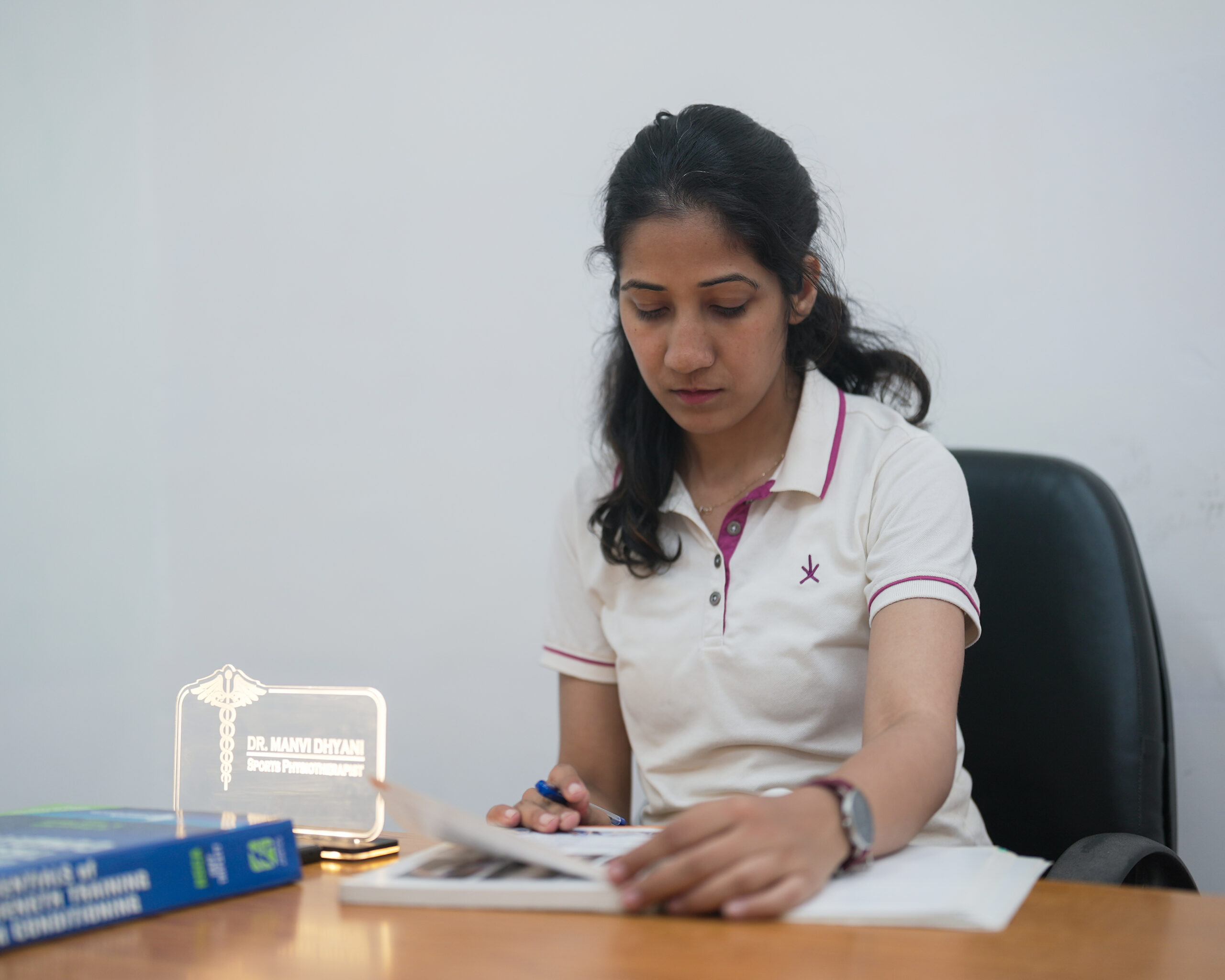
Before I treat any injury, I listen to its story. Because the pain you feel is almost never where the problem actually started. The body compensates. It protects itself. And that compensation is usually where the real work needs to happen.
Dr. Manvi Dhyani, PT, Sports Physiotherapist, Saket, New Delhi
What I actually do differently from session one.
These are not principles. They are the specific things I do in every session that produce different results from what standard physiotherapy produces.
I listen to the history before I touch anything.
When a patient has seen three or four physiotherapists with no result, I know they are already frustrated. The first thing I do is take a proper history. Not a form. A real conversation. Most physiotherapists jump to diagnosis before completing differential diagnosis. That is how the same area keeps being treated while the actual cause goes untouched.
I also identify the patient’s goal specifically. Someone who wants to return to competitive wrestling needs completely different preparation from someone who wants to walk without pain. The programme is built around their actual goal, not a standard protocol for their diagnosis.
Strength testing starts with muscle loss, because the affected side almost always loses muscle first. I take a baseline measurement at the patella and then at two, four, and six centimetres above and below it, so I know exactly how much has been lost and where. From there I compare strength on the injured side against the uninjured side. And because balance is one of the first things that goes after an injury, I check single-leg balance on both sides, eyes open and eyes closed. All of it feeds into how the rehab plan is built.
“When you listen properly to the history, it gives you a very strong foundation for the cause. Your treatment plan should be based on that history and those symptoms.”
Exercise is the foundation. Machines are the adjunct.
Working with international physiotherapists across Australia, Hong Kong, Italy, Germany, and Russia during my time with ProHealth Asia showed me what elite rehabilitation looks like at the highest level. It is exercise-based. Proper warm-ups, progressive strength loading, structured conditioning as a standard part of every programme. Not as an add-on.
Machine-based therapy has a role. It is not the role most clinics in Delhi give it. Making a patient dependent on passive treatment is not rehabilitation. Teaching them to move correctly and building the strength to sustain that movement is.
“There is no replacement for the exercise the person does themselves. Active exercise, not passive. That is what research supports and that is what I see work in practice.”
Mental readiness is as real a clinical finding as muscle weakness.
I have held athletes back from returning to competition when surgeons had already cleared them physically. Not because the strength numbers were wrong. Because the fear was still visible. The body compensates for fear the same way it compensates for pain. An athlete who returns to sport with fear and apprehension in their movement is significantly more likely to reinjure.
I had a patient who had four knee surgeries, two in each knee, and still wanted to return to football. We took six to eight months. We addressed the physical and the mental at the same time. He returned to playing. Mental readiness is not soft work. It is clinical work.
“Until you believe in yourself, I will hold that belief for you. We work together. If you will not help me, I will not be able to help you.”
A clear picture. Not a false timeline to sell a package.
When a patient has been in pain for two years, I do not tell them they will be better in five sessions. That is not kindness. It is dishonesty built around selling a smaller package. I tell them exactly what I think is happening, how long it realistically takes, and what both of us need to do for recovery to work.
In the first session with a long-term pain patient, I do no treatment. I only listen. By the end of that session, they know exactly what I think is causing the problem and what the path forward looks like. A clear picture, even a difficult one, gives a patient what they need to make a real decision about their recovery.
“I never give false hope just to sell a package. Let them choose with a clear picture. That is the only honest way to start a clinical relationship.”
Clearance is a number. Not a feeling.
For ACL cases, I use the Melbourne Protocol before clearing anyone for competitive play. That means the single leg hop test, the triple hop test, and the crossover test, along with single leg bridging and single leg squat, all have to be cleared. Strength has to sit between 90 and 95 percent of the other side, measured through isokinetic testing. Full range of motion, no swelling. Combat sports carry the highest reinjury risk of anything I see, so I am particularly strict here.
Feeling ready and being ready are not the same thing. I have held athletes back from returning to sport after surgeons had already cleared them physically, because the numbers were not there yet.
“Even if the patient feels confident, if the strength is not there, the chance of reinjury is higher. The numbers decide. Not the feeling.”
The pain and the problem are almost never in the same place.
A patient came to me with chronic lower back pain. He had seen multiple physiotherapists. Every one had treated the back. Ultrasound, massage, lumbar exercises. Nothing had worked for more than a few weeks.
When I assessed him properly, I found two things nobody had looked for: a pronated foot on one side and weak glutes. The foot was rolling inward slightly with every step, changing how force traveled upward through the ankle, knee, hip, and into the lower back. The back had been compensating for years. It was the victim, not the cause.
We strengthened the full chain from foot muscles to calf to hamstring to glutes to back. Once the base was strong and the mechanics were corrected, the back pain resolved completely. He had not needed more back treatment. He had needed the right assessment from the beginning.
“Jahan dard hota hai, root cause wahan hona zaroori nahi.”
Listen to the full history
The pattern of the injury reveals more than any scan. I want to know everything before I touch anything.
Assess the joint above and below
If the knee is painful, I check hip internal and external rotation, knee flexion and extension, and ankle inversion, eversion, and dorsiflexion. Compensation often shows up as overpronation or supination at the foot before it ever reaches the painful joint.
Find the root cause
Treating the symptom gives temporary relief. Treating the cause gives lasting resolution. These are rarely in the same place.
Rebuild the base
Strength, stability, functional movement. The goal is never pain relief. The goal is a body that does not return to pain six months later.
Where 12 years were actually spent.
Not a summary. The specific postings, specific sports, and specific outcomes that built the clinical standard I bring to every session in Saket today.
My first on-field posting. Competitive sports teams across India for national events and competitions. CRPF athletes train twice over. Once for service duties and once for sport. The primary clinical challenge was overtraining, not undertraining. I will always cherish what this posting taught me about full athletic commitment. Overuse injuries at this level look completely different from what most physiotherapy training prepares you for.
Field postings to Australia, Hong Kong, Italy, Germany, and Russia. Working alongside international physiotherapists across multiple disciplines showed me what elite rehabilitation looks like at the highest level. Exercise-based as standard. Not machine-based. Strength training and structured conditioning built into every programme as a foundation, not an afterthought.
During this posting I worked ISSF shooting events including the World Championship in Moscow and Junior World Cups in Sydney and Italy, alongside international golf events including the Hong Kong Open, Bangabandhu Cup in Dhaka, and the Hero Women’s Indian Open. Rugby Level 1 and Level 2 certified. Players from the National Hockey Academy batch I worked with are now in the Indian national hockey teams.
National-level athletes within a full multi-disciplinary sports science team: nutritionist, psychologist, anthropometrist, strength and conditioning coach, and physiotherapist working on the same athlete together. This is what integrated athlete care looks like when it is done properly. I was the physiotherapist for India’s Archery team at the 2021 World Archery Youth Championships in Wroclaw, Poland. The team won 15 medals including gold.
Senior clinical and leadership responsibility across 15 sport disciplines. The Chhatrasal wrestling community found me through word of mouth during this period. One wrestler’s ACL rehabilitation sent him back to the mat and back to his teammates with a referral. Wrestlers came to me despite having in-house physiotherapists at Chhatrasal. That referral network built entirely on results, not on marketing.
A practice built on one principle: every patient gets the full hour with the same doctor from the first session to the last. No junior therapist taking over halfway through. No rotation to the next patient. Athletes across wrestling, cricket, football, kabaddi, boxing, badminton, hockey, and skating. Corporate professionals, post-surgery patients, and people with chronic pain that has not responded to previous treatment. All seen with the same standard of clinical attention.
Six things 12 years of treating athletes and patients taught me.
Not clinical theory. What I actually observed across CRPF, SAI Sonipat, ProHealth Asia, and private practice in Saket, and what changed how I treat every patient I see.
Pain free is not recovered. And it is not sport ready either.
The absence of pain is one data point. It is not a discharge criterion. At SAI Sonipat I saw what real return-to-sport assessment looks like at national level: strength ratios, hop tests, movement screening, psychological readiness. Pain stopping is the beginning of recovery, not the end of it. I apply the same criteria to every patient, athlete or not.
The goal of physiotherapy is to make the patient independent, not dependent on physio.
Every session should be teaching the patient something. Every exercise I prescribe has a clinical reason behind it. If I cannot explain why I am doing something, I should not be doing it. A patient who leaves my care knowing how to manage their body is a better outcome than a patient who needs to come back every two weeks indefinitely.
Sports physiotherapy is for every body. Not just athletes.
Degenerative changes happen in every body, whether you play competitive wrestling or sit at a desk in Gurugram for ten hours a day. The assessment does not change between a desk worker and an athlete. I take the same history, run the same Manual Muscle Testing, look at the same movement patterns. What is different is where we are heading. An athlete is training toward hop tests and getting back on the field. A desk worker just wants to move through their day without pain. The exercises look different. The standard behind them does not.
Saying no to activity is rarely the right answer. Modify it.
At CRPF, athletes could not simply stop training because of injury. We had to modify, load manage, and rehabilitate around the training schedule. That constraint taught me something valuable: patients who stay active within appropriate limits recover faster, maintain strength, and avoid the fear-avoidance patterns that turn a physical problem into a chronic one.
Evidence-based clinical reasoning. Not exercises from Instagram.
Working with international physiotherapists in Australia and Europe raised the bar permanently for what I expect of myself clinically. Every decision I make has research behind it. I assess muscle strength, identify the weak link, and build the programme around that specific finding. One size fits all is not a clinical approach. It is an abdication of one.
Mental readiness matters as much as physical readiness. Both need to be treated.
I learned this most clearly at SAI Sonipat, working alongside a psychologist as part of the same multi-disciplinary team. A patient who is physically ready but mentally fearful is not ready to return to sport or to full activity. The fear changes the movement pattern. The movement pattern causes the reinjury. Addressing fear is clinical work, not soft work.
Formal training, registration, and certification.
MPT — Sports Physiotherapy
Jamia Millia Islamia, New Delhi. 2013 to 2015. Master of Physiotherapy with specialisation in Sports Physiotherapy. Jamia Millia Islamia is a central university ranked among the top institutions for physiotherapy training in India.
BPT — Bachelor of Physiotherapy
University of Delhi. 2008 to 2013. Five-year undergraduate programme including one full year of supervised clinical internship across multiple departments.
Registered Physiotherapist — TPR-2666
Delhi Council for Physiotherapy and Occupational Therapy. Registration number TPR-2666. Registered since 2012. Active registration maintained continuously.
Rugby Physiotherapy — Level 1 and Level 2
Certified at Level 1 and Level 2. Worked as match-day physiotherapist for rugby fixtures in Delhi during ProHealth Asia posting. One of the few physiotherapists in Delhi NCR with formal rugby certification.
Effect of Rocker Soled Shoe Design on Walking Economy of Females with Pes Planus
Published in the Journal of Clinical and Diagnostic Research, 2017. Peer-reviewed research on gait mechanics and footwear design in flat-footed individuals, conducted during postgraduate training at Jamia Millia Islamia.
Certified in Spinal and Extremity Mobilisation, Dry Needling, Cupping, Myofascial Release, MET, and PNF
Hands-on treatment is combined with progressive strengthening, never used as a standalone treatment. Correction without rebuilding strength does not hold.
The first session is a conversation. Not a treatment.
Saket, New Delhi. +91 92893 03555
WhatsApp to Book